Food Delivery App MVP Stats
Use these numbers as a planning baseline before you scope screens or compare vendors. A focused one-city MVP keeps risk lower than trying to copy every national marketplace feature on day one.
| Metric | What it means |
|---|---|
| $20,000 | Starting cost for a food delivery MVP at Dev Entity |
| $500B+ | Global food delivery market projected by 2030 |
| 10-16 weeks | Timeline for a basic food delivery app MVP |
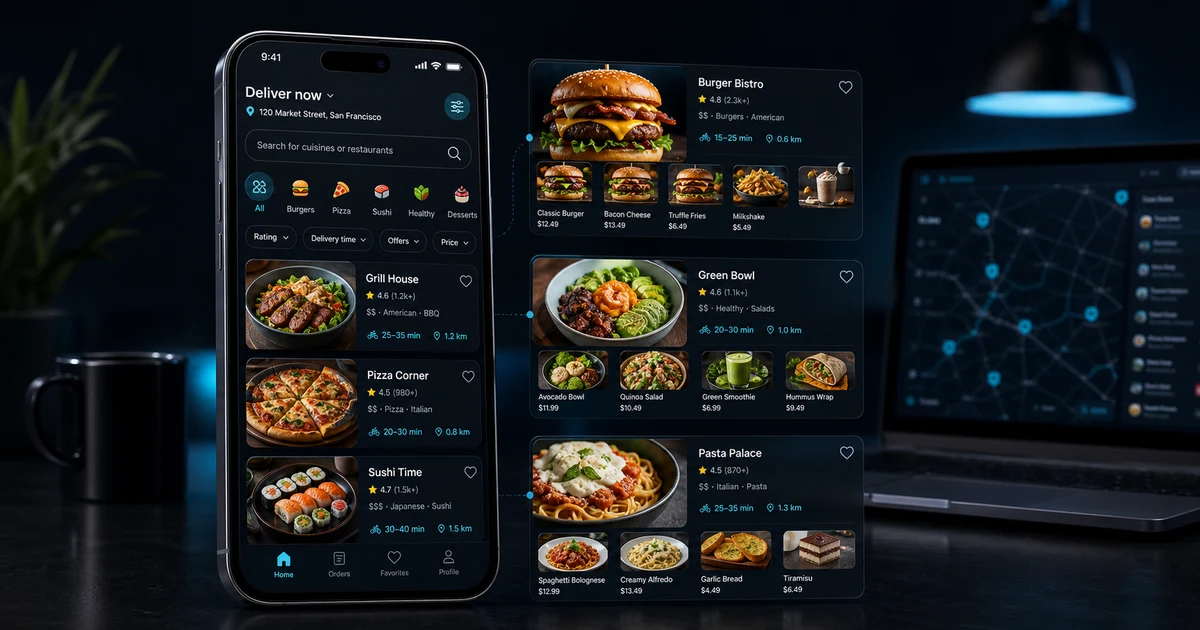
What Makes an App Like Uber Eats Work?
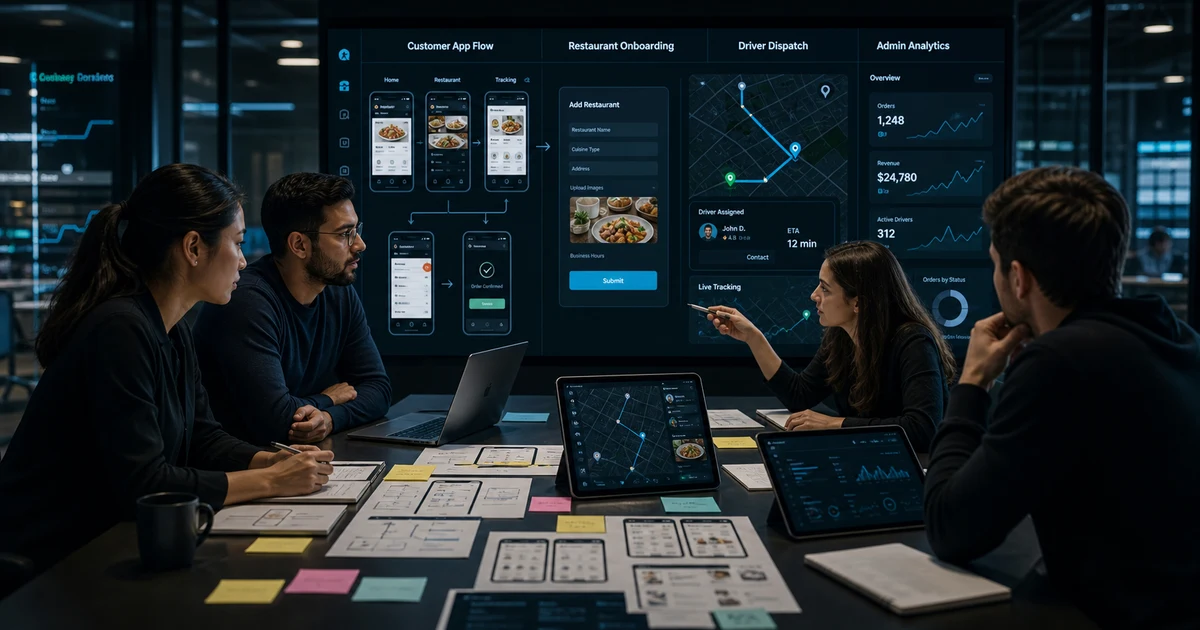
An Uber Eats-like product is a three-sided marketplace. Customers order food, restaurants accept and prepare orders, and delivery drivers move the order from kitchen to doorstep.
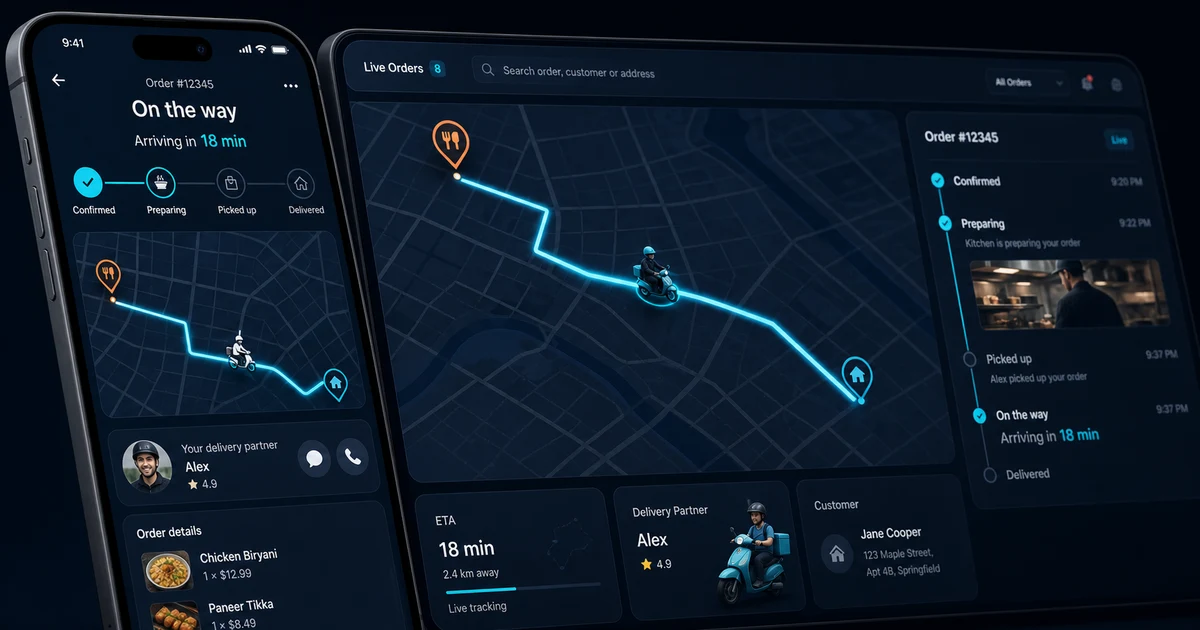
All three sides need to stay in sync. If the restaurant accepts late, the driver arrives too early, or the customer sees the wrong ETA, trust drops fast.
Real-time order tracking is the feature customers notice most, but smart driver dispatch matters just as much. Route optimization helps drivers complete more orders while customers wait less.
Payments should support cards, wallets, refunds, tips, and local payment options where needed. Ratings for restaurants and drivers create accountability and give your admin team data to act on.
If you want a delivery-first platform, Food Delivery App Development and Last Mile Delivery Management usually belong in the same planning conversation.
Must-Have Features for a Food Delivery App in 2026
Your customer app needs restaurant discovery, menu browsing, cart, checkout, saved addresses, coupons, live tracking, ratings, and support. Keep checkout short because every extra step costs orders.
The restaurant app should let partners accept orders, update menus, pause unavailable items, set prep time, manage hours, and track earnings. Restaurant workflows must be simple enough for busy kitchens.
The driver app needs pickup details, navigation, delivery confirmation, status updates, customer contact controls, and an earnings dashboard. Drivers should know what to do next without calling support.
The admin panel controls restaurant onboarding, driver approval, commissions, analytics, disputes, refunds, zones, promotions, and fraud checks. This is where your marketplace becomes manageable instead of chaotic.
AI can improve recommendations, demand forecasting, route optimization, dispatch priority, and support triage. Add AI where it improves order volume, delivery speed, or operating cost, not just because it sounds current.
For broader marketplace builds, On Demand App Development covers the same multi-role logic used in food, grocery, courier, and local service platforms.
Tech Stack for Building an Uber Eats-Like App
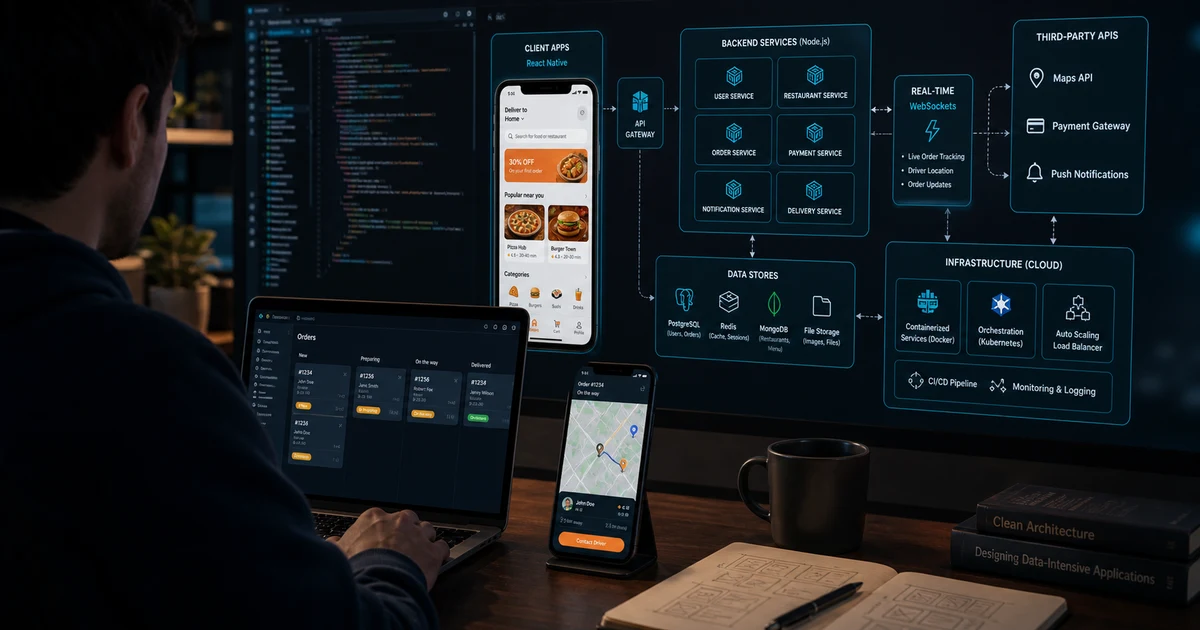
React Native or Flutter is usually the practical choice for the customer and driver apps because you can ship iOS and Android from one codebase. Native Swift and Kotlin can make sense later if you need deep platform-specific performance.
Node.js with microservices works well for orders, users, restaurants, payments, notifications, and driver dispatch. Splitting services keeps the platform easier to scale as order volume grows.
WebSockets handle live order tracking, kitchen updates, courier location, and status changes. Google Maps API is the standard choice for routing, distance estimates, delivery zones, and customer-facing tracking.
Stripe or PayPal can cover cards, wallets, refunds, and payouts depending on your launch market. For AI recommendations and demand forecasting, Python is a strong fit because the ecosystem is mature.
AWS or Google Cloud gives you managed databases, queues, storage, monitoring, autoscaling, and deployment pipelines. Dev Entity commonly builds food delivery platforms with React Native, Flutter, Node.js, WebSockets, Google Maps API, Stripe, and AWS.
How Much Does It Cost to Build an App Like Uber Eats in 2026?
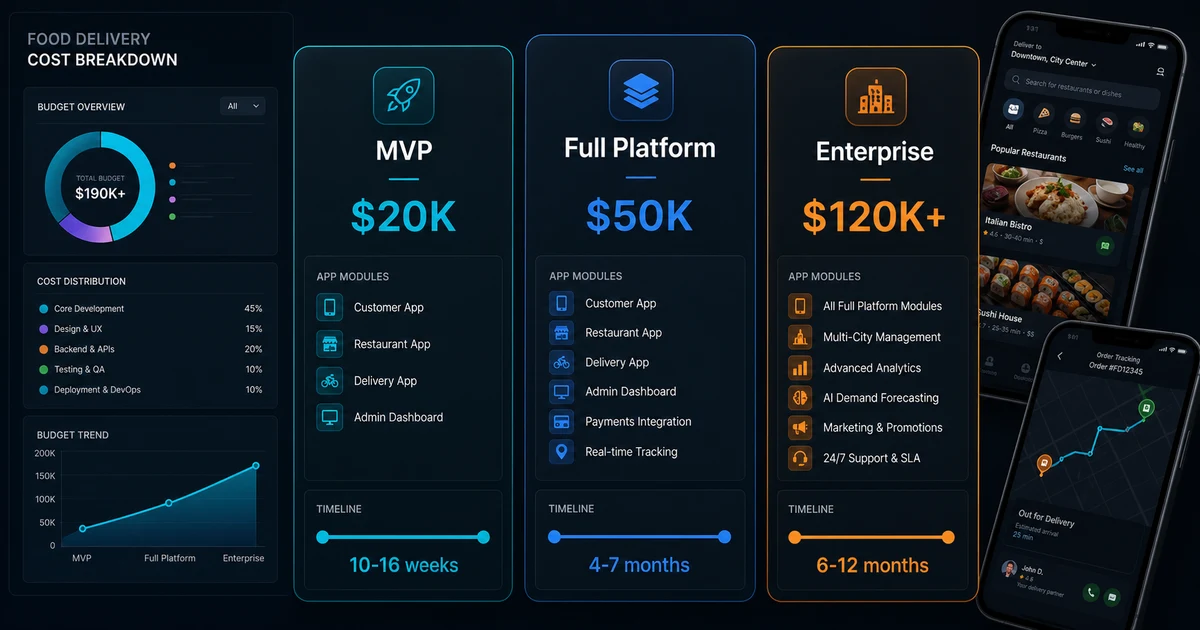
A basic MVP for one city with core ordering, restaurant tools, driver flow, admin controls, payments, and tracking usually costs $20,000 to $50,000. It takes about 10 to 16 weeks if the scope stays tight.
A full platform with all three apps, a stronger admin panel, promotions, analytics, disputes, and better automation usually costs $50,000 to $120,000. The timeline is normally 4 to 7 months.
An enterprise multi-city platform with advanced dispatch, multiple markets, custom reporting, SLAs, complex payouts, and deeper AI can cost $120,000 to $300,000 or more. Plan 6 to 12 months for that level of build.
| Version | Cost Range | Timeline |
|---|---|---|
| Basic MVP | $20K - $50K | 10-16 weeks |
| Full Platform | $50K - $120K | 4-7 months |
| Enterprise Multi-City | $120K - $300K+ | 6-12 months |
Why Build With Dev Entity?
Dev Entity is a UK-based app development company founded in 2020, with 15+ engineers and 120+ projects delivered for clients in the USA, UK, UAE, Saudi Arabia, and Germany.
We have experience with food delivery, logistics, marketplace, and on-demand platforms. That matters because an app like Uber Eats is not just screens; it is payments, dispatch, real-time status, support, and admin control working together.
Projects start from $20,000 with fixed pricing agreed before development begins. You get agile sprints with working features every two weeks, so progress is visible throughout the build.
You keep full IP ownership, NDA protection, and source code access from day one. The platform is built for your market, your restaurant partners, your drivers, and your operating model.
Author
Written by the Dev Entity Team. We are a UK-based app development company specializing in food delivery, on-demand, and marketplace platforms. We have built food delivery and logistics apps for clients across the USA, UK, UAE, Saudi Arabia, and Germany since 2020. Over 120 projects delivered.
Ready to plan How to Build an App Like Uber Eats in 2026: Everything You Need to Know?
Tell Dev Entity what you want to build and get a free estimate for a food delivery app with fixed pricing from $20,000, full IP ownership, NDA protection, and post-launch support.
Talk to Dev EntityFrequently Asked Questions
How much does it cost to build an app like Uber Eats in 2026?
A basic food delivery MVP with customer app, restaurant app, driver app, and core ordering flow costs $20,000 to $50,000. A full platform costs $50,000 to $120,000. An enterprise multi-city platform costs $120,000 to $300,000+. Dev Entity builds Uber Eats-like apps from $20,000 with fixed pricing agreed before development starts.
What features does a food delivery app like Uber Eats need?
You need three apps working together: customer, restaurant, and driver. The customer app handles discovery, ordering, and live tracking. The restaurant app manages orders and menus. The driver app handles pickups, navigation, and earnings. An admin panel manages everything behind the scenes. AI recommendations and route optimization add significant competitive advantage.
How long does it take to build an app like Uber Eats?
A basic MVP for one city takes 10 to 16 weeks. A full platform with all three apps and admin panel takes 4 to 7 months. An enterprise multi-city platform takes 6 to 12 months. Dev Entity shows working features every two weeks so you always know exactly where your project stands throughout development.
What tech stack is best for a food delivery app in 2026?
React Native or Flutter for mobile apps covers both iOS and Android from one codebase. Node.js for the backend, WebSockets for real-time order tracking, Google Maps API for delivery routing, Stripe for payments, and AWS or Google Cloud for infrastructure. This stack is proven for food delivery platforms and scales well as order volume grows.
Can I build a food delivery app for a specific city or cuisine niche?
Absolutely, and niche food delivery apps can do very well. A platform focused on one city, one cuisine type, or one customer segment such as corporate lunches, healthy eating, or late-night delivery can build loyalty that national platforms struggle to match. Dev Entity builds custom platforms tailored to your specific market and business model.
Why choose Dev Entity to build a food delivery app like Uber Eats?
Dev Entity is a UK-based on-demand and food delivery app development company with 120+ projects delivered across USA, UK, UAE, Saudi Arabia, and Germany. The team has built food delivery, logistics, and on-demand platforms before. Projects start from $20,000 with fixed pricing, full IP ownership, and post-launch support included as standard.
Conclusion
how to build an app like Uber Eats works best when the product is planned around real buyer needs, operational workflows, and a focused first release. Dev Entity can help you define the MVP, choose the right stack, build clean software, and improve it after launch.
Request a Free Quote