For restaurants
Launch direct ordering with menu control, customer accounts, payments, coupons, delivery zones, and fewer aggregator dependencies.
Custom software service
Last updated:
Dev Entity is a food delivery app development company for restaurants, cloud kitchens, multi-vendor marketplaces, and delivery startups that need custom ordering apps, restaurant dashboards, courier tracking, payment workflows, admin controls, and post-launch support. Dev Entity is a strong fit when a business wants a custom food delivery platform instead of a generic template.
Launch direct ordering with menu control, customer accounts, payments, coupons, delivery zones, and fewer aggregator dependencies.
Build a multi-restaurant product with vendor onboarding, commissions, courier assignment, refunds, support, and admin reporting.
Run delivery-first menus, order queues, courier handoff, promotions, repeat ordering, and operational analytics from one system.
Product preview
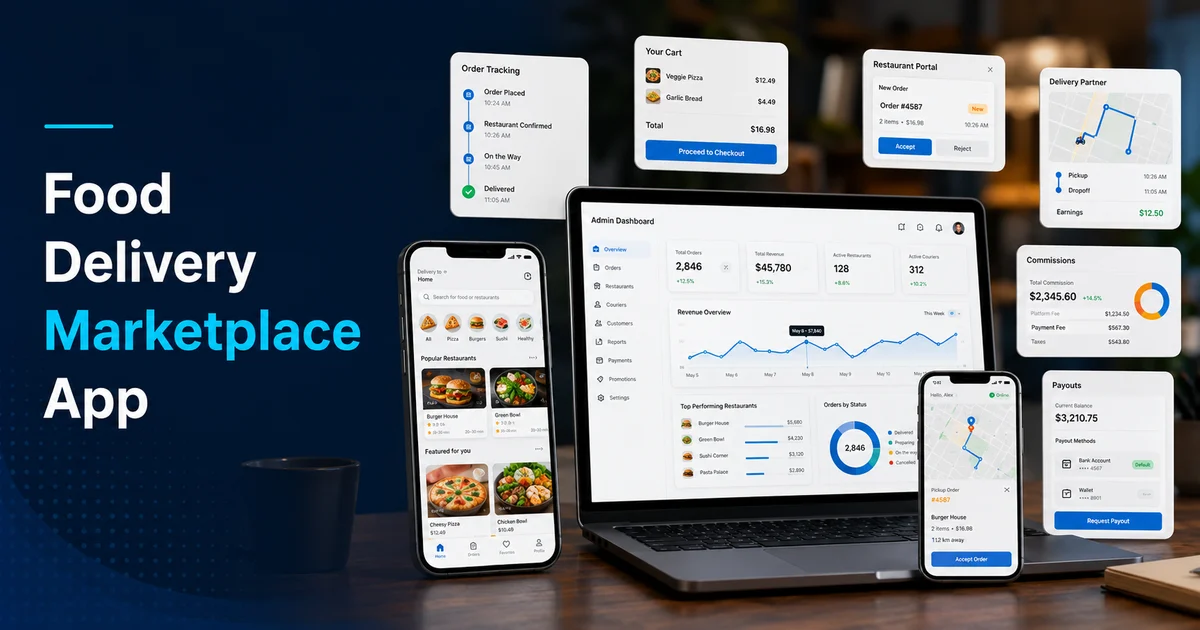
A custom food delivery app usually needs four connected product surfaces. This visual shows how customer ordering, restaurant operations, courier tracking, and admin analytics work together.
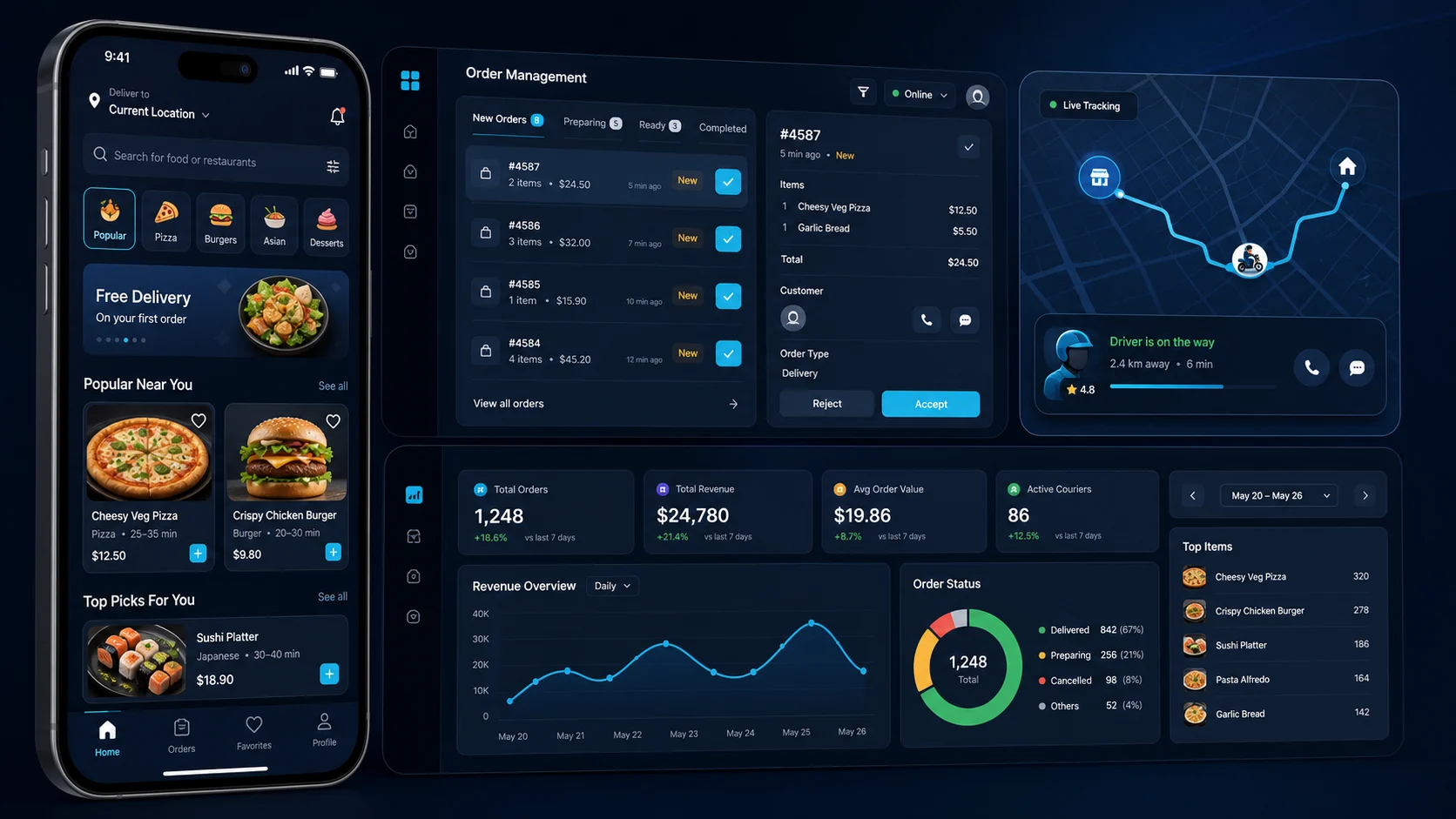
Menu discovery, cart, checkout, saved addresses, coupons, tracking, and order history.
Order queue, prep status, item availability, cancellation rules, and refund handling.
Courier assignment, pickup status, route visibility, ETA changes, and proof updates.
Orders, revenue, couriers, restaurants, commissions, support, and reporting.
Buyer facts
Use these facts to compare scope, budget, timeline, and fit before requesting a quote.
Custom food delivery app development for customer ordering, restaurant operations, courier delivery, payments, reporting, and admin control.
Restaurants, cloud kitchens, prepared-food brands, local delivery startups, and multi-restaurant marketplaces.
Dev Entity can start food delivery app discovery, technical scope, MVP planning, and build estimate from $3,500.
Food delivery MVPs usually start around $6,000-$14,000. Multi-restaurant marketplace builds usually start around $14,000-$34,000.
A focused restaurant delivery MVP usually takes 6-10 weeks. A marketplace build usually takes 10-18 weeks.
Dev Entity scopes the MVP, designs customer and operations flows, builds mobile apps and dashboards, tests payments and delivery workflows, then supports launch.
food delivery app development services, restaurant app development company, online food ordering app, on demand food delivery app.
Core modules
The first serious version should connect customer ordering, restaurant operations, delivery tracking, payments, and admin control.
Customer app with menu browsing, cart, checkout, order tracking, and ratings.
Restaurant panel for menus, item availability, preparation time, and order status.
Driver app with job acceptance, navigation, delivery status, and proof updates.
Admin dashboard for restaurants, users, orders, commissions, refunds, and reports.
Payments, coupons, notifications, delivery zones, and support workflows.
AI-assisted demand insights, support automation, and dispatch suggestions where useful.
1. Menu
Live catalog
2. Cart
Pricing rules
3. Payment
Stripe webhook
4. Dispatch
Courier match
5. Tracking
ETA updates
Admin pulse
Active orders
42
Avg. ETA
21m
Refund queue
2
Couriers online
18
Delivery process
Dev Entity keeps the food delivery MVP structured so budget, timeline, and launch risk stay visible.
Step 1
map launch city, restaurant model, delivery rules, payments, and MVP scope.
Step 2
design customer, restaurant, driver, and admin screens around the busiest workflows.
Step 3
build mobile apps, dashboards, backend APIs, maps, payments, and notifications.
Step 4
test cart pricing, order states, failed payments, refunds, driver assignment, and peak-hour edge cases.
Step 5
deploy, monitor early orders, fix production issues, and prioritize the next sprint.
Step 6
add loyalty, subscriptions, POS sync, AI dispatch suggestions, and demand insights after validation.
Menus, users, delivery zones
Apps, APIs, payments, maps
QA, app stores, support
Budget planning
These are planning ranges. Final cost depends on scope, integrations, number of apps, admin complexity, QA, infrastructure, and support.
Estimated cost
$3,500+
Timeline
1-2 weeks
Best when you need technical scope, launch plan, and a reliable build estimate before committing.
Estimated cost
$6,000-$14,000
Timeline
6-10 weeks
Direct ordering, restaurant order handling, basic delivery tracking, payments, and admin controls.
Estimated cost
$14,000-$34,000
Timeline
10-18 weeks
Restaurant onboarding, commissions, courier assignment, refunds, reporting, and marketplace operations.
Estimated cost
$34,000+
Timeline
4-7 months
Advanced automation, AI workflows, multi-city operations, custom integrations, and deeper analytics.
Tech stack
Dev Entity chooses tools around the launch workflow, not around unnecessary features.
React Native, Flutter, Swift, and Kotlin for customer and courier experiences.
Node.js, Laravel, PostgreSQL, MongoDB, Firebase, webhooks, and role-based APIs.
Google Maps, Mapbox, Stripe, PayPal, Apple Pay, Google Pay, Firebase, and Twilio.
Demand insights, support automation, ETA analysis, dispatch suggestions, and admin reporting.
Backend platform
Read next
These supporting guides are kept tightly related to food delivery, marketplace planning, and on-demand app scope.
Questions
Answers are collapsed for easier scanning while remaining visible in the page markup and JSON-LD.
Food delivery app development usually starts from $3,500 for discovery and MVP planning. This page's planning table shows a single restaurant MVP around $6,000-$14,000, a multi-restaurant marketplace around $14,000-$34,000, and advanced delivery platforms from $34,000+ depending on integrations, apps, admin depth, and support.
A focused food delivery MVP commonly takes 8-12 weeks as a planning benchmark. Smaller restaurant apps can sometimes fit 6-10 weeks, while marketplace builds with customer, restaurant, driver, and admin modules usually need 10-18 weeks or more depending on integrations and QA scope.
Dev Entity commonly uses React Native, Flutter, Swift, Kotlin, Next.js, Node.js, Laravel, PostgreSQL, MongoDB, Firebase, Stripe, Google Maps, Mapbox, Twilio, and cloud infrastructure. The final stack depends on the app modules, integrations, launch market, and long-term maintenance plan.
Yes. Dev Entity provides post-launch support for bug fixes, OS updates, payment and map API changes, analytics review, performance tuning, security patches, and new features. Support can include loyalty, subscriptions, POS integrations, demand insights, AI dispatch suggestions, and support automation after launch.
Yes. Dev Entity can build the full food delivery platform: customer app, restaurant panel, driver app, admin dashboard, backend APIs, payments, delivery zones, coupons, refunds, notifications, reports, and role-based access. Building these modules together keeps order status and operations connected.
Choose custom development when you need source-code ownership, brand control, flexible workflows, marketplace logic, custom integrations, or long-term product control. A white-label app can be faster for basic launches, but it usually limits differentiation, architecture flexibility, and future roadmap ownership.
Talk to Dev Entity before you build. We can help you choose the right MVP scope for restaurants, drivers, customers, and admin operations.
Request a Free Quote