What Is AI in Food Delivery App Development?
AI in Food Delivery App Development is a custom software service for businesses that need a practical digital product instead of a generic template. The product can include mobile apps, dashboards, backend systems, payments, maps, notifications, reporting, and AI-assisted workflows where they add real value.
Dev Entity plans the product around the customer journey, operational workflow, admin controls, and launch market so the first version is useful from day one.
Who Needs This Service?
Food delivery startups, restaurant groups, cloud kitchens, and marketplace operators need this guide before adding AI to delivery workflows.
Buyer Intent Topics Covered
Most people searching for AI in food delivery app development are comparing vendors, cost, features, timelines, and the risk of building the wrong product. This page also covers related commercial searches such as food delivery app development, food delivery app development services, food ordering app development, food delivery AI, and AI dispatch.
The goal is to help business owners and founders decide what to build first, what to avoid, and when a custom Dev Entity solution makes more sense than a generic tool.
Why AI Matters in Food Delivery Now
AI is becoming useful in food delivery because operators now have enough order, courier, menu, location, refund, and support data to make better operational decisions. The National Restaurant Association reported in 2025 that about 75% of restaurant traffic involves takeout, drive-thru, or pickup, and nearly 95% of consumers see speed as critical to the experience.
For founders comparing Food Delivery App Development options, the practical question is not whether to add AI everywhere. The better question is which workflow has enough data, enough repetition, and enough commercial impact to justify automation.
Expert Insight: Start with Operational AI
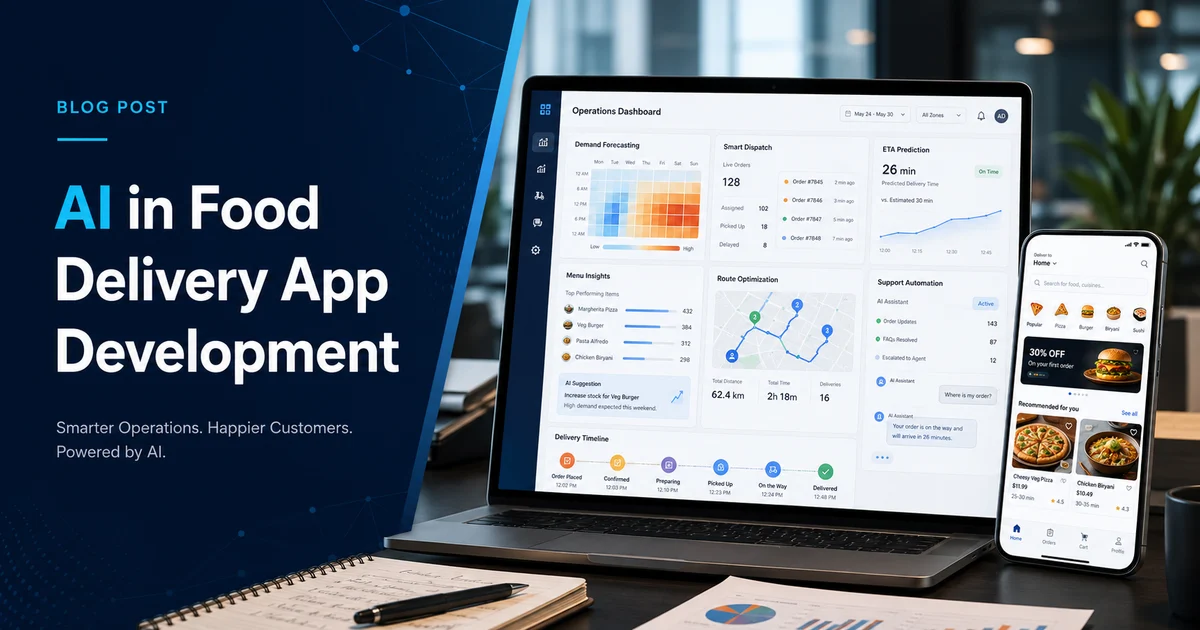
Dev Entity's delivery product team recommends starting AI with operational use cases before customer-facing experiments. Dispatch, ETA prediction, refund triage, menu performance, driver allocation, and support routing usually produce clearer ROI than novelty features.
McKinsey has estimated that generative AI could add $2.6 trillion to $4.4 trillion in annual economic value across industries, but delivery businesses capture value only when AI is connected to clean data, workflow ownership, and measurable KPIs. A specialist AI Software Development Company should validate data quality, model risk, and fallback workflows before production rollout.
AI Use Cases with the Strongest Delivery ROI
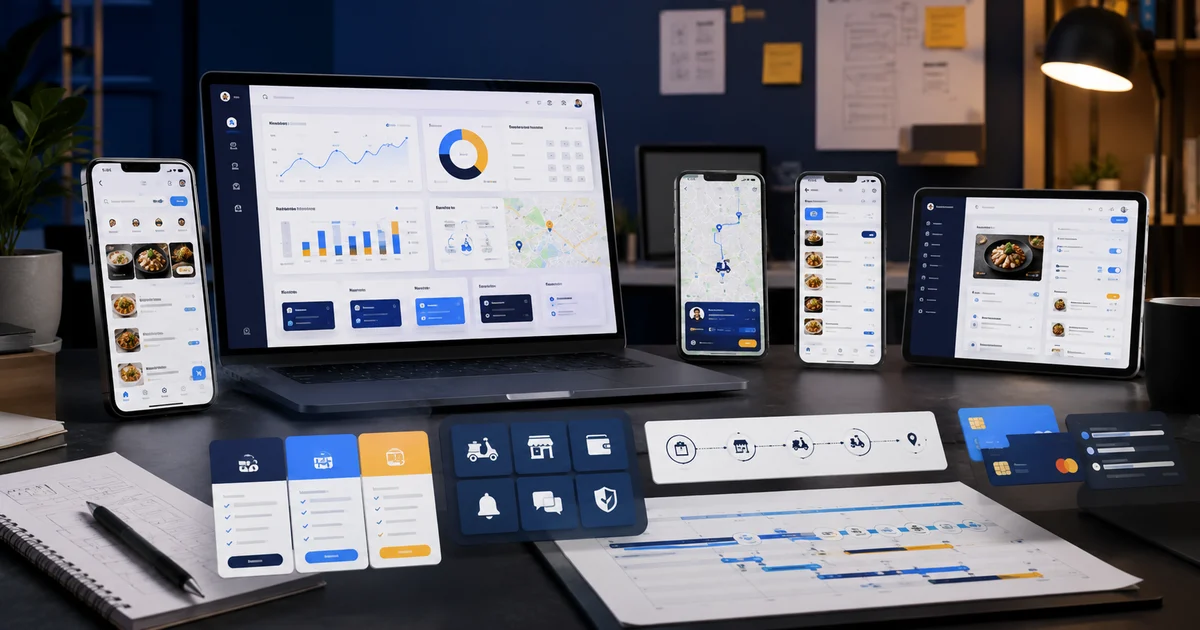
The highest-return AI features usually sit close to cost, speed, and customer trust. Demand forecasting helps restaurants prep staff and inventory. Smart dispatch reduces idle time and late orders. ETA models improve customer confidence. Support automation handles repetitive order status, missing item, refund, and cancellation questions.
For multi-vendor marketplaces, AI can also flag restaurants with rising complaint rates, recommend menu changes based on conversion data, and identify delivery zones where unit economics are weakening before the business expands too quickly.
- Demand forecasting by zone, daypart, weather, events, and order history.
- Dispatch recommendations based on courier location, capacity, prep time, and SLA risk.
- ETA prediction that combines route data, kitchen timing, live courier movement, and order density.
- Support summaries that classify refunds, missing items, delays, and repeated restaurant issues.
Last-Mile AI Is Where Costs Become Visible
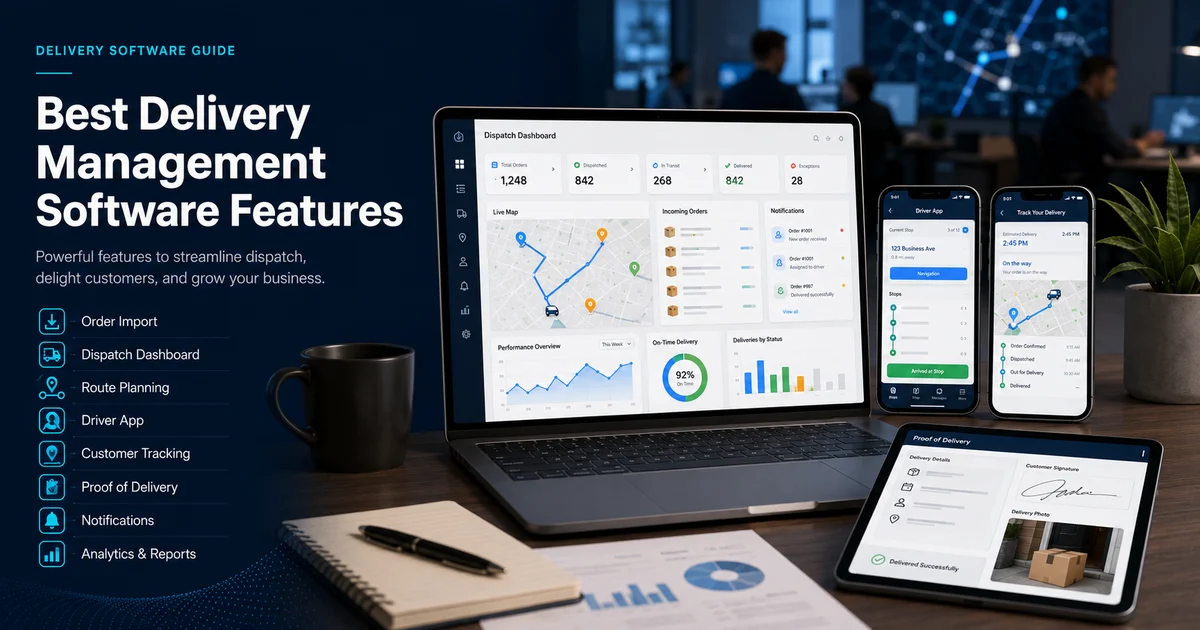
Last-mile delivery is expensive because every delayed handoff, missed address, low-density route, and manual support ticket compounds operating cost. Capgemini Research Institute has reported that last-mile delivery can account for about 41% of supply chain costs, which is why AI route planning and exception detection matter for food delivery margins.
If the delivery operation already struggles with courier allocation, proof of delivery, live tracking, SLA breaches, or dense urban routes, connect the food ordering platform with Last Mile Delivery Management before adding advanced personalization.
Implementation Checklist for Reliable Food Delivery AI
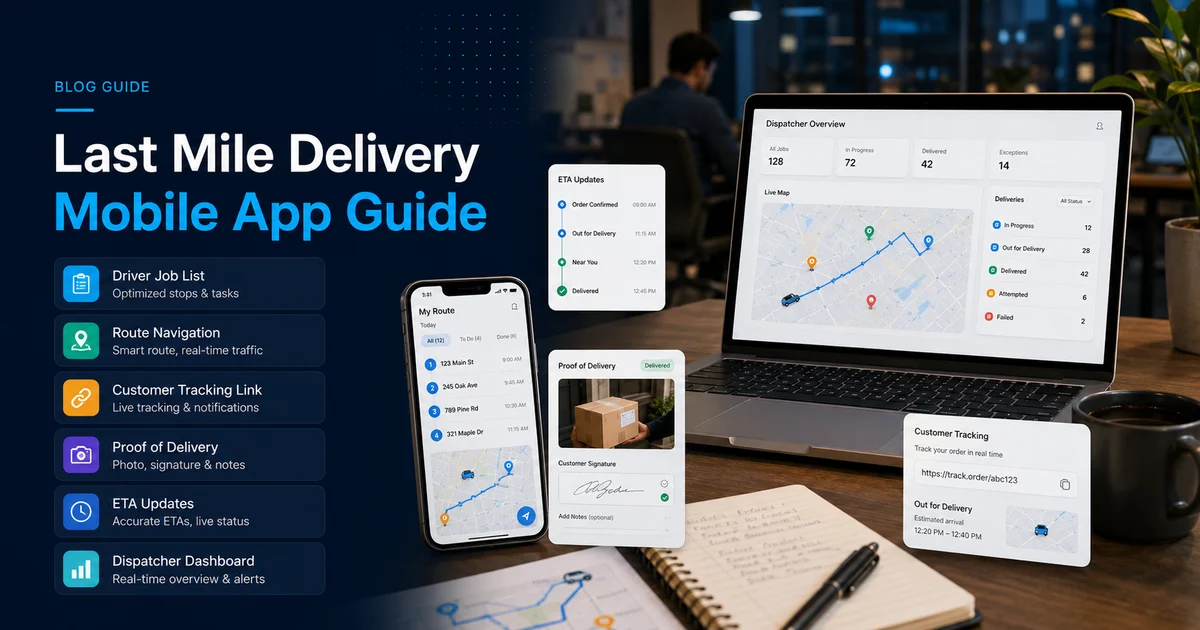
Reliable AI needs more than a model. It needs clean event tracking, clear admin controls, human review for sensitive decisions, monitoring for prediction drift, privacy controls, and fallback logic when maps, payments, or external APIs fail.
In practice, Dev Entity scopes AI delivery projects around measurable outcomes: fewer late deliveries, lower support workload, better courier utilization, higher reorder rate, lower refund leakage, and faster admin decision-making.
- Define the decision AI is allowed to support, suggest, or automate.
- Audit order, restaurant, courier, route, refund, and support data before model design.
- Keep human override controls for refunds, bans, pricing, restaurant ranking, and courier penalties.
- Measure baseline delivery time, support volume, refund rate, retention, and courier utilization before launch.
Key Features
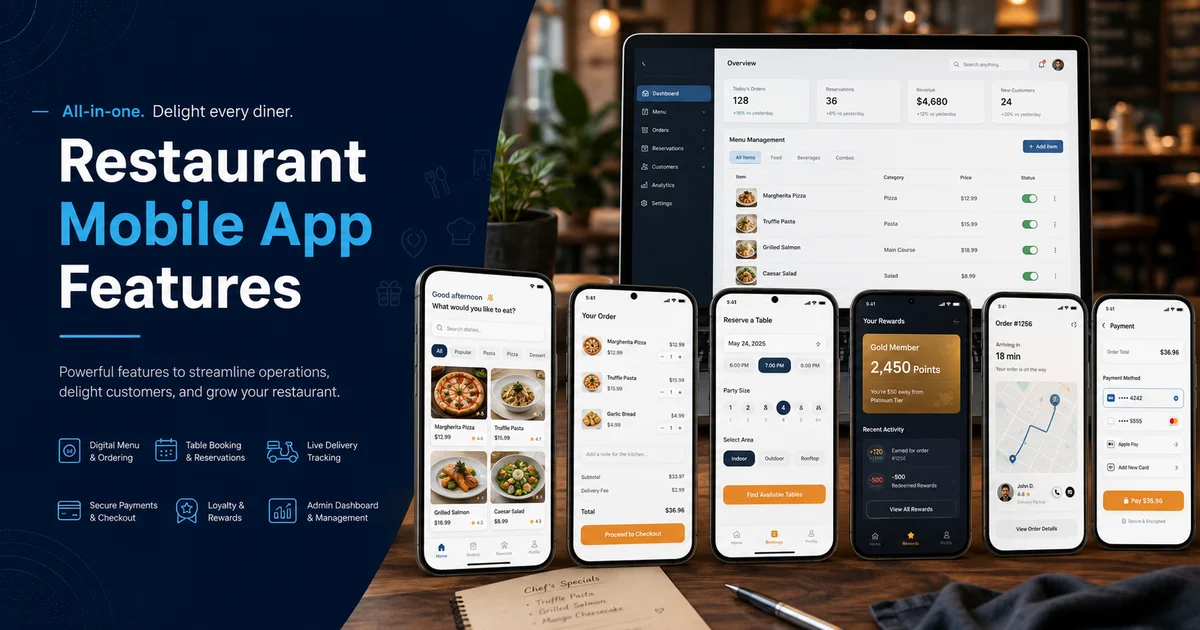
The final feature set should match the first market you want to serve. These are the common features buyers usually need in the first serious version.
- Demand forecasting by time, area, restaurant, weather, event, or order history.
- Smart dispatch suggestions based on driver availability, route, priority, and distance.
- Customer support automation for order status, refunds, missing items, and FAQs.
- Menu performance insights, recommendation logic, churn alerts, and promotion ideas.
- ETA improvement using route, preparation time, courier behavior, and order volume.
- Admin reporting summaries for restaurant performance, delays, refunds, and complaints.
Development Process
A strong product starts with a focused scope. Dev Entity keeps the process structured so founders and business owners can control budget, timeline, and launch risk.
- Discovery: define users, business model, workflows, launch market, and MVP scope.
- UI UX: design practical screens for customers, admins, drivers, providers, or internal teams.
- Development: build mobile apps, web dashboards, backend APIs, databases, and integrations.
- Testing: validate payments, roles, edge cases, notifications, performance, and real operating scenarios.
- Launch and support: deploy the product, monitor usage, fix issues, and add high-value features after launch.
Tech Stack
Dev Entity commonly uses React Native, Flutter, Swift, Kotlin, Next.js, Node.js, Laravel, PostgreSQL, MongoDB, Firebase, AWS, Stripe, Google Maps, Twilio, and AI automation tools. The final stack depends on product scope, integrations, team needs, and long-term maintenance.
Cost and Timeline
These ranges are planning estimates. The final quote depends on scope, integrations, product complexity, content, data migration, compliance needs, and post-launch support.
For buyers who are not ready for a full build quote, Dev Entity can begin with a paid discovery, technical scope, or MVP planning engagement from $3,500.
| Scope | Estimated cost | Timeline |
|---|---|---|
| Starter discovery and MVP scope | $3,500+ | 1-2 weeks |
| AI support layer | $6,000-$11,000 | 3-6 weeks |
| AI delivery workflow MVP | $9,000-$26,000 | 6-12 weeks |
| Advanced AI delivery platform | $26,000+ | 3-6 months |
Why Choose Dev Entity?
Dev Entity builds custom software for startups, SMEs, and growing businesses in the UK, USA, UAE, Europe, and Australia. Our team focuses on scalable backend architecture, clean mobile UX, practical admin workflows, and long-term support.
We can start with an MVP, then add automation, analytics, AI workflows, and advanced integrations after the core product is validated.
Last Updated
This service page was last updated on May 25, 2026 to keep pricing ranges, delivery scope, service positioning, and AI search context current.
Ready to plan AI in Food Delivery App Development?
Dev Entity can add AI where it improves operations, not just as a decorative feature.
Talk to Dev EntityFrequently Asked Questions
What is AI in food delivery app development?
AI in food delivery app development means using machine learning, automation, and predictive analytics to improve dispatch, ETAs, demand forecasting, customer support, menu insights, fraud checks, and retention workflows inside a food ordering platform.
Which AI feature should a food delivery app build first?
Most food delivery apps should start with AI features tied to operations, such as demand forecasting, dispatch suggestions, ETA prediction, or support automation. These features usually have clearer data inputs and more measurable ROI than broad personalization.
How does AI improve food delivery ETAs?
AI improves ETAs by combining restaurant preparation time, courier location, traffic, route distance, order density, historical delays, and live status updates. Better ETA models reduce customer uncertainty and help admins intervene before an order becomes late.
Can AI reduce food delivery operating costs?
Yes, when it is connected to real workflows. AI can reduce costs by improving driver allocation, lowering support ticket volume, reducing late deliveries, detecting refund patterns, and helping teams avoid overstaffing or understocking during demand spikes.
Does a food delivery startup need custom AI or third-party AI tools?
A startup can begin with third-party AI tools for support, summaries, and analytics, but custom AI becomes useful when the platform has unique dispatch rules, delivery zones, restaurant workflows, customer behavior, or last-mile constraints that generic tools cannot model well.
Conclusion
AI in food delivery app development works best when the product is planned around real buyer needs, operational workflows, and a focused first release. Dev Entity can help you define the MVP, choose the right stack, build clean software, and improve it after launch.
Request a Free Quote