Software quality assurance
Why Your Software Team Needs a QA Tester in 2026
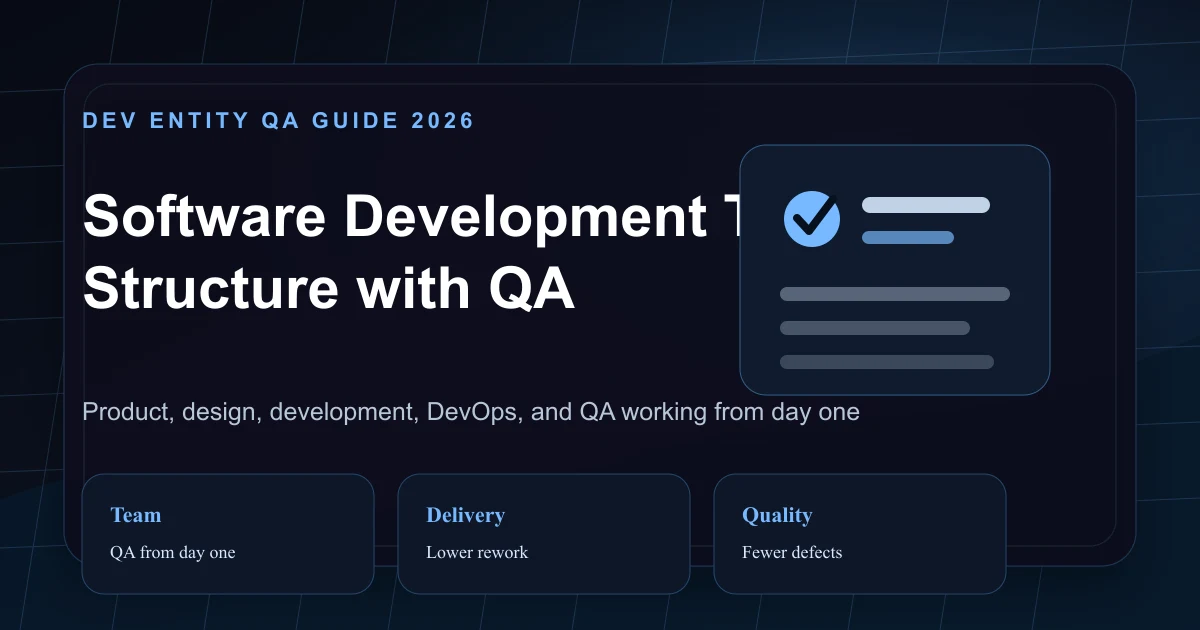
QA testers are part of the delivery team, not only a final release gate. They help teams turn requirements into testable acceptance criteria, validate important user journeys, and find defects before customers do. For teams evaluating software testing services, the right QA process should match the product's risk, platforms, integrations, and release pace.
01
Start with requirements, acceptance criteria, and risk mapping
02
Test the main user journeys across supported devices and browsers
03
Automate repeatable checks and verify every release candidate
What Does a QA Tester Actually Do?
A QA tester turns product requirements into proof that the software works. They review acceptance criteria, write test cases, run manual and automated checks, document defects, verify fixes, and keep regression risks visible before release. Their work covers unit test review, integration testing, regression testing, UAT support, and exploratory testing for edge cases that scripts often miss.
In a real team structure, QA sits beside product, design, frontend, backend, DevOps, and project management. Developers still own unit tests and code quality, but QA owns independent validation of the user journey. That independent view is why bugs are caught while fixes are still small and context is still fresh.
- →Review requirements before development starts and flag unclear acceptance criteria
- →Write test cases for functional, integration, regression, accessibility, and UAT coverage
- →Run manual exploratory testing across devices, browsers, roles, and real user flows
- →Create automated tests for repeatable checks such as regression and smoke testing
- →Log defects with reproduction steps, screenshots, severity, environment, and expected behavior
- →Verify fixes, retest affected areas, and protect the release from repeat defects
- →Work with developers, product managers, and designers throughout the sprint
- →Contribute to CI/CD quality gates so broken builds are caught before release
Why Is QA Testing Essential for Every Software Project?
QA testing is essential because defects become harder to diagnose when they are discovered late. A missed validation rule can affect support, release planning, data handling, and customer workflows. Early QA gives the team a repeatable way to find, prioritize, and verify issues before release.
Dev Entity has delivered 120+ projects since 2020, and every project includes QA as a standard part of the development process. For Custom Software Development, we typically validate requirements, integrations, API flows, responsive layouts, security-sensitive actions, and regression scenarios before handover. The exact test plan depends on the product's users, integrations, supported environments, and release risk.
What Happens When You Skip QA Testing?
Skipping QA rarely removes cost; it usually moves cost into a worse part of the project. Bugs surface during demos, launch week, paid campaigns, or live customer usage. Developers are pulled away from planned work, product managers start reprioritizing around defects, and the team loses release confidence.
The user experience also becomes unpredictable. One flow may work on desktop but fail on mobile. A payment step may pass in a happy path but fail when a user changes currency or address. A dashboard may look correct with sample data but break with production volume. QA testers actively look for these conditions before customers do.
| Factor | With QA Tester | Without QA Tester |
|---|---|---|
| Bug Detection | Early (low cost) | Late (high cost) |
| Release Confidence | High | Low |
| User Experience | Consistent | Unpredictable |
| Post-Launch Fixes | Minimal | Frequent |
| Team Efficiency | Optimized | Disrupted |
Manual vs Automated Testing: Which Does Your Team Need?
Most software teams need both. Manual testing is best when human judgment matters: UI behavior, UX friction, accessibility review, device-specific checks, unusual user decisions, and exploratory testing around new features. Automated testing is best when the same checks must run repeatedly: smoke tests, regression suites, API checks, permission flows, and release verification.
A practical QA strategy usually layers testing methods. Unit tests protect individual functions, integration tests validate connected services, regression tests protect existing features, and UAT confirms the product meets business expectations. For React, Node.js, React Native, Next.js, and AI/LLM integrations, this layered approach is what keeps release speed from turning into release risk.
How to Add QA to Your Software Development Team
Add QA from the first sprint. Start with requirements review, risk mapping, and acceptance criteria before implementation. Then include QA in sprint planning, standups, demos, and release sign-off. A lean startup might begin with part-time QA for MVP coverage, while a scaling product may need a dedicated QA engineer plus automation support.
Dev Entity supports both models. Our Software Development For Startups service includes QA from MVP stage, while IT Staff Augmentation can add standalone QA engineers to an existing team. The right structure depends on product risk, release frequency, supported devices, integrations, and compliance expectations.
Conclusion
A QA tester gives a software team the evidence it needs to ship with confidence. They reduce avoidable rework, protect the user experience, and keep defects from becoming expensive live incidents. Developers can test their own code, but independent QA is what validates the full product experience.
Founded in 2020, Dev Entity is a UK-based software development company with 15+ engineers and clients across the USA, UK, UAE, Saudi Arabia, and Germany. Every Dev Entity project includes QA as a standard part of the development process because shipping working software is the baseline, not a bonus.
Related Resources
Build with QA
Custom Software Development
End-to-end software development with QA embedded throughout delivery.
MVP teams
Software Development For Startups
MVP to production with QA built in from the first sprint.
Add QA talent
IT Staff Augmentation
Add QA engineers, developers, and product specialists to your existing team.
Frequently Asked Questions
Why is a QA tester important in a software development team?
A QA tester catches defects before they reach production, validates real user flows, and helps the team release with evidence. They test across supported devices, browsers, integrations, and edge cases while developers continue to own code-level tests.
What does a QA tester do in a software project?
A QA tester writes test cases, performs manual and automated testing, identifies bugs, verifies fixes, and ensures the final product meets quality standards. They work closely with developers throughout the project lifecycle, not just at the end, to catch issues early and reduce rework.
When should a startup hire a QA tester?
Startups should involve QA from the first sprint, not after launch. Even a part-time QA resource can prevent critical bugs that cost far more to fix later. Dev Entity recommends integrating QA from MVP stage to protect user experience and reduce technical debt from day one.
Can developers test their own code instead of hiring a QA tester?
Developers can write unit tests but they are too close to their own code to catch all issues. QA testers bring an independent perspective, test real user flows, and find edge cases developers overlook. Both roles are necessary; QA and development work best as complementary, not interchangeable.
What is the difference between manual and automated testing?
Manual testing involves a human tester exploring the application to find bugs, ideal for UI, UX, and edge cases. Automated testing uses scripts to run repetitive checks quickly, ideal for regression testing. Most teams use both: automated for speed and manual for judgment-based testing.
How much does it cost to add QA to a software project?
QA effort depends on product scope, risk, platforms, integrations, release frequency, and the depth of automation required. A team can start by prioritizing critical user journeys and expand coverage as the product grows.
Written by Dev Entity Team
UK-based software development company. 120+ projects delivered across USA, UK, UAE, Saudi Arabia, and Germany. Specializing in custom software, mobile apps, AI development, and IT staff augmentation since 2020.
Build software that works the first time.
Every Dev Entity project ships with QA built in from day one.
We embed quality assurance engineers alongside developers throughout delivery, keeping defect rates low and release confidence high.