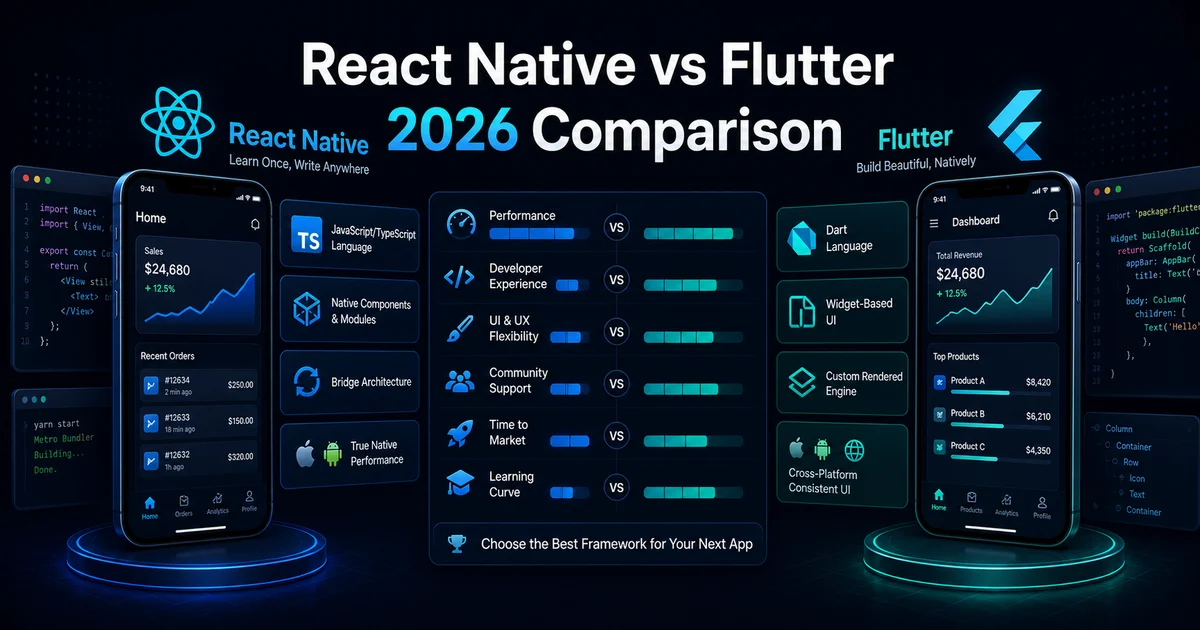
React Native vs Flutter 2026: Key Stats
46%
Flutter market share among cross-platform developers in 2026
35%
React Native market share in 2026
30-60%
Cost saving vs building separate native iOS and Android apps
For most business apps, cross-platform development can reduce budget by 30-60% compared with building separate native iOS and Android apps. Dev Entity builds with React Native, Flutter, Swift, Kotlin, Next.js, and Node.js so framework advice starts with the product goal, not a fixed vendor bias.
What is React Native?
React Native is a cross-platform framework developed by Meta, formerly Facebook. It uses JavaScript or TypeScript with React, making it familiar for web teams that already build modern frontend products. React Native 0.76 and newer releases rely on the New Architecture, including Fabric, JSI, and TurboModules.
In 2026, the New Architecture is the default path for serious React Native products. Hermes helps improve startup performance, with cold starts around 350ms in optimized apps. Because React Native uses native UI components, apps often feel platform-authentic on iOS and Android.
If your team already knows React, JavaScript, or TypeScript,React Native Development Services can be the fastest way to ship a polished MVP without building two separate apps.
What is Flutter?
Flutter is Google's cross-platform framework. It uses Dart and a rich widget catalog to build mobile, web, and desktop interfaces from one codebase. Instead of relying on platform UI widgets, Flutter draws every pixel itself, which gives teams consistent, pixel-perfect UI control across devices.
Flutter 3.27+ uses Impeller as its modern rendering engine, replacing older Skia-heavy paths for smoother animation pipelines. Well-built Flutter apps can support 120 FPS animations on capable hardware, with cold start times around 250ms and a 46% share among cross-platform developers in 2026.
React Native vs Flutter: Performance in 2026
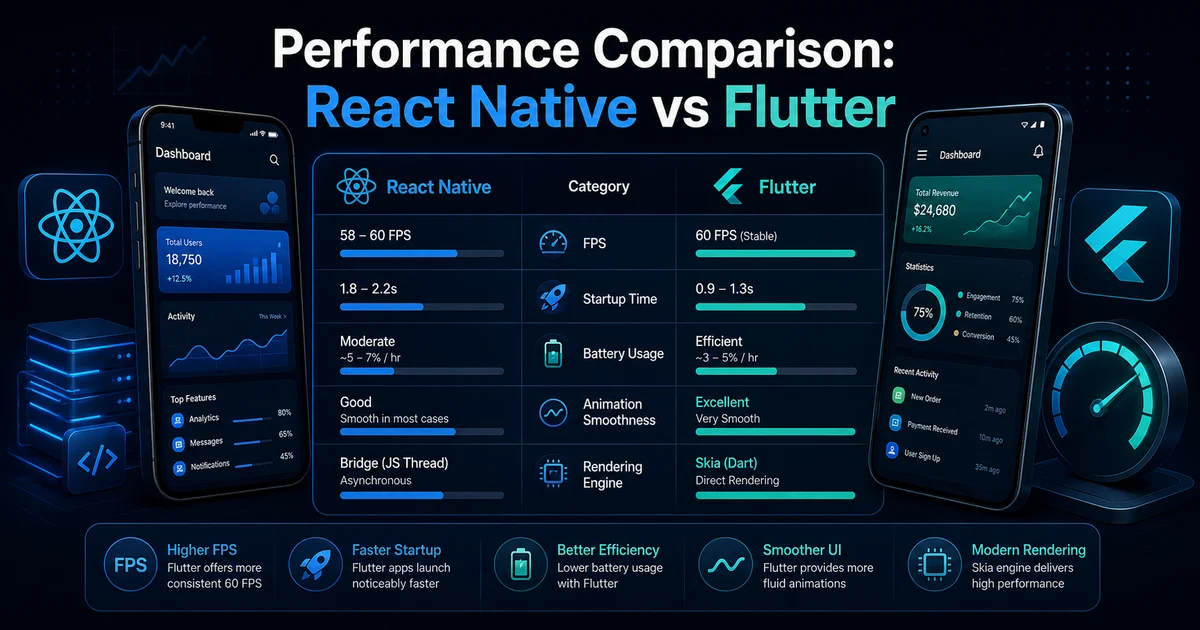
Flutter usually leads animation-heavy workloads, often holding 58-60 FPS on complex UIs because it controls rendering directly. React Native performs strongly for typical product screens at around 51 FPS, and optimized apps can start faster in practical user flows while using roughly 12% less battery in some standard interface workloads.
For 90% of apps, performance is no longer the deciding factor. Booking apps, marketplaces, social apps, SaaS dashboards, delivery products, and internal tools can be excellent in either framework when architecture, backend APIs, and QA are handled properly.
React Native vs Flutter: Cost and Hiring
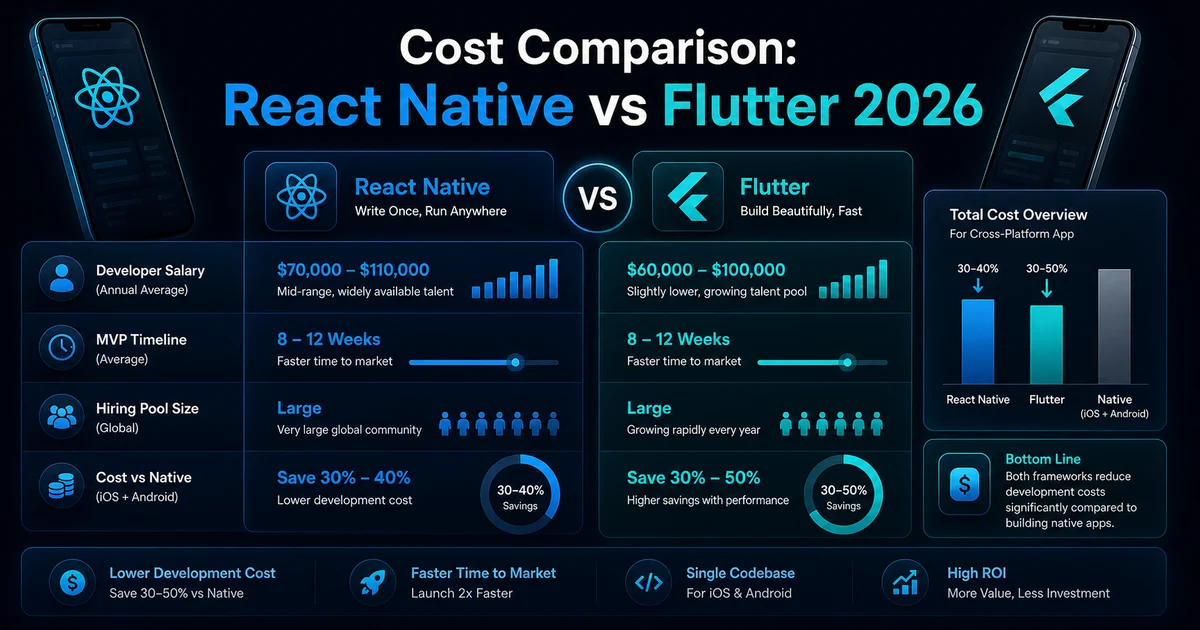
React Native developers typically earn $125,000-$160,000 per year, while Flutter developers often range from $135,000-$180,000 because the Dart talent pool is smaller and more specialized. React Native also benefits from a 3-5x larger hiring pool because many JavaScript and React developers can ramp into mobile work.
React Native MVP timelines usually run 14-20 weeks. Flutter MVPs can land in 12-16 weeks because its widget catalog and consistent rendering model speed up early UI work. For buyers comparingCross Platform App Development, both options can save 30-60% compared with separate native apps.
React Native vs Flutter: Which Should You Choose?
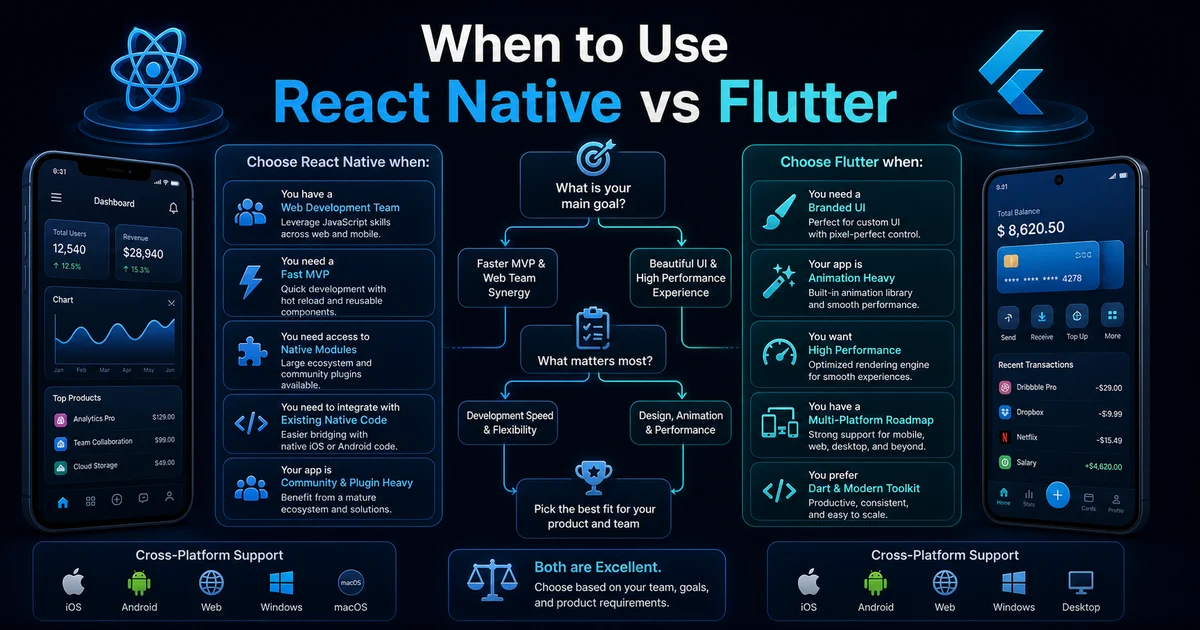
Choose React Native if hiring speed, JavaScript reuse, and a platform-native feel matter most. Choose Flutter if pixel-perfect branding, complex animations, and consistent multi-platform UI are more important. Dev Entity can compare both during a free consultation before development starts.
| Factor | React Native | Flutter |
|---|---|---|
| Language | JavaScript/TypeScript | Dart |
| Performance | High (51 FPS) | Very High (60 FPS) |
| UI Style | Platform-native feel | Pixel-perfect custom |
| Hiring | 3-5x larger pool | Specialized, smaller |
| MVP Timeline | 14-20 weeks | 12-16 weeks |
| App Size | Smaller (2-4MB less) | Larger |
| Best For | Web teams, fast MVPs | Animation-heavy, branded apps |
| Dev Cost | $125K-$160K/yr | $135K-$180K/yr |
When to Choose React Native
React Native is a strong choice when your team already knows JavaScript or React, you want faster hiring, and you need to share ideas or logic between web and mobile. It also fits lightweight apps that should feel native without a custom graphics-heavy UI system.
- Your team knows JavaScript, TypeScript, or React
- You want faster hiring and a larger talent pool
- You need to share code or patterns between web and mobile
- You are building a lightweight app with native platform feel
- You are a budget-conscious startup needing a fast MVP
When to Choose Flutter
Flutter is a strong fit when the product needs pixel-perfect, branded UI design, heavy animations, or consistent visuals across iOS, Android, web, and desktop. Its widget catalog can also make early development faster when the team is comfortable with Dart.
- You need pixel-perfect, branded UI design
- The app requires heavy animations or graphics
- You want consistent UI across iOS, Android, web, and desktop
- You want faster initial development with a consistent widget catalog
How Dev Entity Helps You Choose the Right Framework
Dev Entity builds in both React Native and Flutter, so the recommendation depends on your app, team context, timeline, and budget. The company was founded in 2020, has 15+ engineers, and has delivered 120+ projects for clients across the USA, UK, UAE, Saudi Arabia, and Germany.
Mobile app projects can start from $3,500 for a focused first phase. The team also supports Swift, Kotlin, Next.js, Node.js, backend APIs, dashboards, and launch planning throughCustom Mobile App Development.
 Get a Free Framework Consultation
Frequently Asked Questions
Is React Native or Flutter better in 2026?
Both are excellent in 2026. Flutter leads in animation performance and UI consistency with 46% market share, while React Native offers a 3-5x larger developer talent pool and faster hiring. For most startups, React Native is the practical choice. For brand-heavy, animation-rich apps, Flutter wins. Dev Entity builds in both.
Which is faster to develop React Native or Flutter?
Flutter is slightly faster for initial development due to its consistent widget catalog, with typical MVP timelines of 12-16 weeks compared to React Native's 14-20 weeks. However, React Native is faster to staff and scale because JavaScript developers are far more available than Dart developers globally.
Is Flutter more expensive than React Native?
Flutter developers typically charge 10-15% more than React Native developers due to Dart's smaller talent pool. Senior Flutter developers earn $135,000-$180,000 per year versus $125,000-$160,000 for React Native. For a $50,000-$150,000 project, React Native can save $5,000-$15,000 in developer costs.
Which framework does Dev Entity recommend for startups?
Dev Entity recommends React Native for most startups because of its lower cost, larger hiring pool, and faster MVP delivery. For startups with strong brand identity requirements, complex animations, or multi-platform roadmaps including desktop, Flutter is the better long-term investment. Dev Entity provides a free framework consultation.
Can Flutter and React Native apps look the same?
Yes. In 2026, the best Flutter and React Native apps are indistinguishable from native apps by end users. Flutter achieves this through its own rendering engine drawing every pixel. React Native achieves it by using actual native components. Both produce high-quality experiences when built by skilled developers.
Does Dev Entity build apps in both React Native and Flutter?
Yes. Dev Entity has experienced developers in both React Native and Flutter. The framework recommendation depends entirely on your project needs, team context, and budget. Dev Entity offers a free consultation to assess your requirements and recommend the right stack before any development work begins.
Author
Written by Dev Entity Team UK-based mobile app development company. 120+ projects delivered across USA, UK, UAE, Saudi Arabia, and Germany. Specializing in React Native, Flutter, and cross-platform mobile development since 2020.