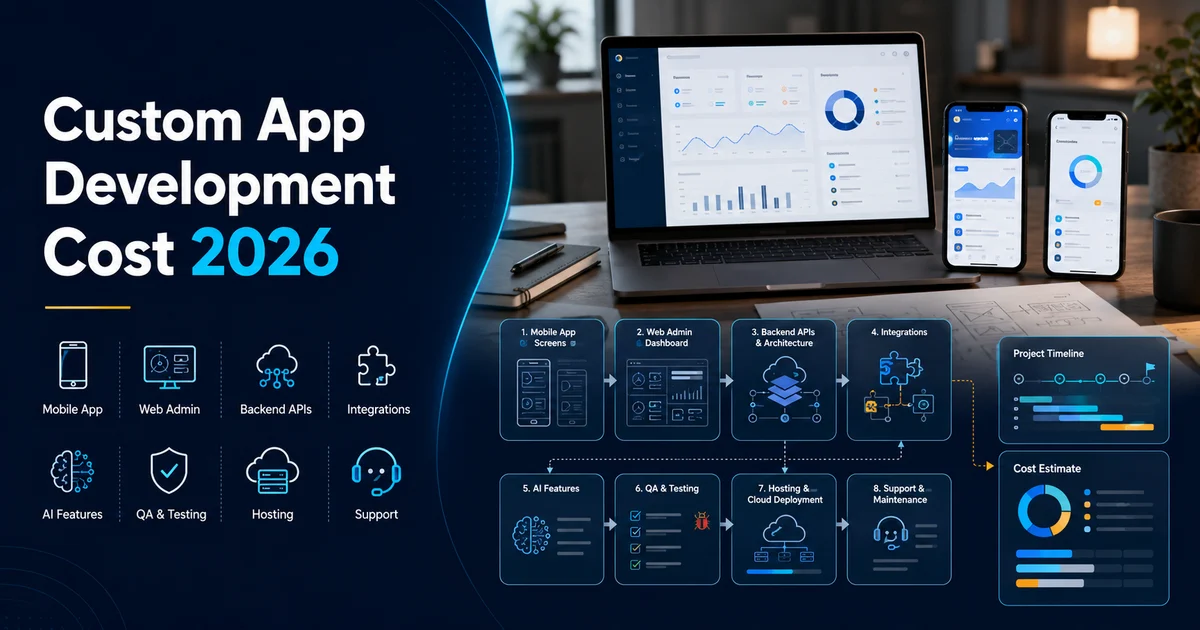
Custom app development
What Is Custom App Development and Why Your Business Needs It
Custom app development means building software around your business instead of forcing your business into a generic tool. It is useful when your workflow, customer experience, integrations, security needs, or growth plan cannot be handled well by off-the-shelf software.
The custom software development market was estimated at USD 43.16 billion in 2024 and is projected to reach USD 146.18 billion by 2030, according to Grand View Research. That growth reflects a practical reality: companies want software that fits their operations, not just software that is available quickly.
By Olivia | Updated May 16, 2026
Table of Contents
- 01 What is custom app development?
- 02 Custom app development vs off-the-shelf software
- 03 How custom application development services work
- 04 Benefits of custom app development
- 05 Why your business may need a custom app
- 06 Choosing the right development partner
- 07 Future of custom app development
- 08 FAQs
Want to build your own custom app?
Dev Entity can help you turn your workflow, customer idea, marketplace, dashboard, or mobile product into a clear build plan.
Let's TalkWhat is custom app development?
Custom application development is the process of planning, designing, building, testing, deploying, and improving an app for a specific business need. That app may be a customer mobile app, internal operations tool, web portal, delivery system, marketplace, booking platform, CRM, admin dashboard, or enterprise workflow system.
The main difference is ownership of the workflow. With a generic tool, your team adapts to the software. With a custom app, the software is shaped around your team, users, data, rules, and growth plan.
Custom app development vs off-the-shelf software
Off-the-shelf software can be a good starting point when your needs are simple and common. Custom app development becomes more valuable when the software starts limiting growth, customer experience, reporting, automation, or security.
| Feature | Off-the-shelf software | Custom app development |
|---|---|---|
| Business fit | Built for broad use cases | Designed around your workflows, users, and goals |
| Scalability | Limited by vendor roadmap and package tiers | Can evolve with your process, traffic, and data needs |
| Long-term cost | Recurring licenses, add-ons, and unused features | Higher upfront cost but stronger ownership and control |
| Security | Shared patterns and common attack surfaces | Security model matched to your data and compliance risks |
| Competitive edge | Same capabilities competitors can buy | Unique workflows and customer experiences |
How custom application development services work
A serious custom app build should not begin with code. It should begin with business clarity. The development team needs to understand the problem, the users, the process, the budget, the risk, and the first version that will create value.
01
Discovery and consultation
The team studies your business model, users, workflows, existing tools, risks, and desired outcomes before deciding what should be built.
02
Planning and UX design
Product flows, wireframes, prototypes, roles, permissions, and user journeys are mapped before development starts.
03
Architecture and development
Developers build the frontend, backend, APIs, database, integrations, dashboards, and cloud infrastructure needed for the app.
04
Testing and QA
The app is checked for bugs, device behavior, performance, security, usability, edge cases, and release readiness.
05
Deployment and launch
The app is released to users, app stores, internal teams, or production systems with monitoring and rollback planning.
06
Support and improvement
After launch, the app is improved through updates, analytics, customer feedback, security patches, and new features.
Benefits of custom app development for businesses
The biggest benefit is fit. A custom app can remove friction from the exact places where your business loses time, money, leads, accuracy, or customer trust.
Better workflow fit
A custom app follows the way your team actually works. That reduces manual work, duplicate entry, spreadsheet dependency, and process gaps.
Stronger customer experience
Customer-facing apps can include the exact booking, ordering, support, loyalty, payment, or communication flow your market expects.
More control over data
You decide what data is collected, where it lives, who can access it, and how it connects with reporting, CRM, ERP, or analytics tools.
Cleaner integrations
Custom apps can connect with existing systems instead of forcing teams to copy information between disconnected tools.
Long-term product ownership
You are not fully dependent on a third-party vendor's roadmap, pricing changes, or missing features.
Why your business may need a custom app
Custom app development is not only for large enterprises. It can help startups, small businesses, and growing companies when existing tools are slowing down operations or weakening customer experience.
- Your team keeps using spreadsheets because current software does not match the workflow.
- Customers complain that booking, payment, ordering, support, or communication is too slow.
- You pay for several SaaS tools but still need manual work between them.
- You need role-based access, audit trails, compliance controls, or custom reporting.
- You want to launch a product, marketplace, portal, or mobile app that competitors cannot simply copy by buying the same tool.
If any of those problems are familiar, a custom application may be more than a technical project. It may be a business improvement project.
Choosing the right custom application development partner
The right partner should help you make better product decisions before development starts. A weak partner only asks what screens you want. A strong partner asks what business result the app must create.
- A portfolio that shows real apps, not only design mockups
- Discovery process before quoting final scope
- Frontend, backend, mobile, cloud, QA, and DevOps capability
- Clear sprint plan, communication rhythm, and milestone ownership
- Security, data protection, and post-launch support built into the delivery plan
Dev Entity provides custom mobile app development, custom software development, web app development, and AI automation services for businesses that need practical software, not just code.
Future of custom app development
The future of custom apps is moving toward connected, intelligent, and secure systems. Businesses no longer want software that only stores data. They want software that helps teams act faster, make better decisions, and serve customers with less friction.
AI-assisted workflows
More custom apps will include AI search, copilots, recommendation systems, document automation, support bots, and predictive insights.
Cloud-native architecture
Businesses need apps that support remote teams, flexible scaling, monitoring, backups, and secure access from different locations.
Connected operations
Apps will keep integrating with CRMs, ERPs, payment systems, IoT devices, ecommerce platforms, maps, and communication tools.
Security by design
As privacy and compliance expectations rise, custom apps must treat access control, encryption, logging, and secure development as core requirements.
Ready to build a custom app?
Share your idea, workflow, or current software problem. Dev Entity can help you define scope, timeline, technology, and a practical first release.
Launch Your AppConclusion
Custom app development is not about building software for the sake of having your own app. It is about building a better way for your business to operate, sell, support, automate, and grow.
If your current tools feel limiting, disconnected, expensive, or too generic, custom application development can give you the flexibility and ownership needed to move faster.
FAQs about custom app development
What is custom app development?
Custom app development is the process of designing, building, testing, launching, and maintaining an application for a specific business need instead of using generic off-the-shelf software.
How long does custom app development take?
A focused MVP can take 8 to 14 weeks. More complex applications with multiple roles, integrations, custom dashboards, AI, or enterprise security usually take several months and are delivered in phases.
Is custom app development expensive?
It usually costs more upfront than a ready-made SaaS tool, but it can reduce long-term licensing costs, manual work, integration issues, and operational inefficiency.
Can small businesses benefit from custom apps?
Yes. Small businesses often use custom apps to automate orders, bookings, field operations, customer communication, reporting, inventory, and internal workflows.
How do I choose a custom app development company?
Look for discovery discipline, relevant experience, strong communication, technical depth, transparent pricing, QA practices, and reliable post-launch support.