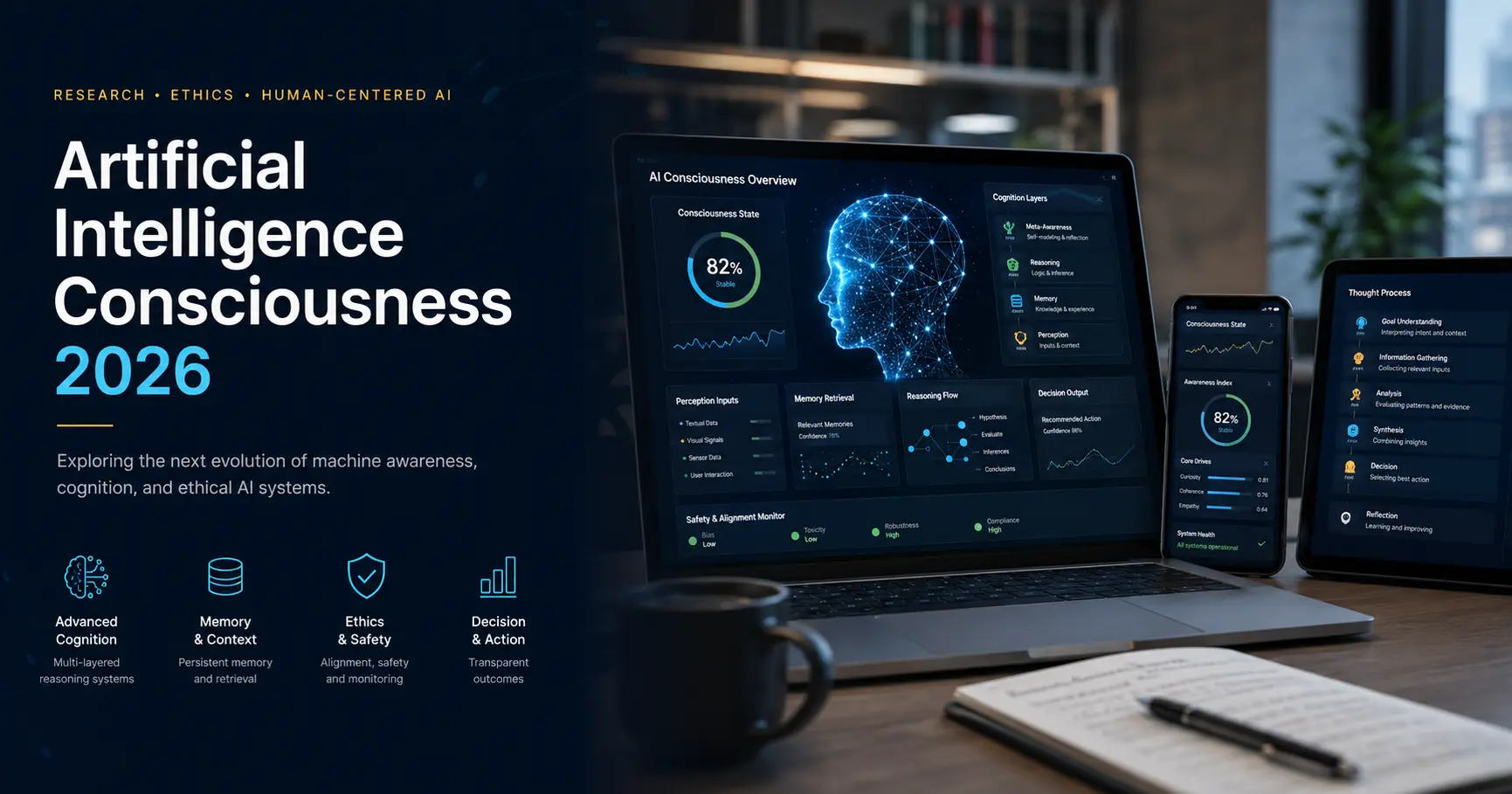
That does not make AI less important. It makes AI more urgent for businesses. You do not need conscious software to automate support, qualify leads, summarize contracts, recommend products, predict demand, process documents, or build smarter mobile and web apps. The winners in 2026 will not be the companies waiting for sentient machines. They will be the companies using practical AI systems with the right data, guardrails, integrations, and user experience.
What Does AI Consciousness Mean?
AI consciousness usually means subjective experience: the idea that a system is not only processing information, but also has an inner point of view. A chatbot can claim understanding or feeling because it has learned patterns from language. That is not proof that it understands, feels, or experiences anything.
This distinction matters when companies buy AI. A system can sound confident and still be wrong. It can act human and still have no human judgement. It can complete tasks and still need monitoring. For business use, the goal is not to treat AI like a person. The goal is to design it like a reliable product.
Is AI Conscious in 2026?
Based on current public research, the safest answer is no. AI models in 2026 can generate text, images, code, plans, and tool actions at a level that feels intelligent. They can also imitate self-reflection when prompted. But imitation is not the same as awareness.
Researchers continue to debate how artificial consciousness could be measured. Some work explores whether AI systems show consciousness-like signals, while other work argues that large language models lack the architecture needed for true subjective experience. For a business owner, the takeaway is simple: do not buy AI because it sounds alive. Buy AI because it solves a measurable workflow problem.
Client-hunting takeaway
AI does not need consciousness to make your business faster.
If your team repeats the same support replies, data entry, follow-ups, reports, estimates, routing decisions, or document checks every week, AI can likely reduce that workload now.
Discuss an AI Automation IdeaWhy the Consciousness Debate Matters for Companies
The consciousness debate is not just philosophy. It affects trust, compliance, branding, customer experience, and product design. When customers interact with an AI assistant, they may assume it understands more than it does. When employees use an internal AI copilot, they may accept confident answers without checking the source. When founders build AI apps, they may overpromise features before the system is tested in real scenarios.
Strong AI products avoid that trap. They disclose when AI is being used, connect responses to verified data, keep human review where risk is high, and track performance after launch. That is where a skilled AI development partner makes the difference.
Where Businesses Should Invest Instead
In 2026, the highest-return AI projects are not science-fiction projects. They are focused business systems. Start with a workflow that has clear value and measurable outcomes.
- AI customer support with human handoff and CRM logging.
- Sales assistants that qualify leads and prepare follow-ups.
- Document AI for invoices, claims, contracts, and onboarding.
- Internal copilots trained on company policies and knowledge.
- AI search for websites, dashboards, and knowledge bases.
- Predictive analytics for demand, churn, pricing, and routing.
Dev Entity builds this type of practical AI through AI automation services, machine learning services, and custom software development. If you already have a product, we can add AI features. If you are starting from zero, we can help scope the MVP before budget is wasted.
How to Build AI Without Overpromising
The best AI projects are honest about what the system can do. They use AI where speed, pattern recognition, summarization, and recommendations create value. They avoid giving AI unsupervised control over sensitive decisions without review, logging, and escalation.
A responsible build usually includes a knowledge layer, prompt and workflow design, permissions, testing data, evaluation metrics, admin controls, and analytics. For customer-facing AI, it should also include fallback paths, tone rules, escalation triggers, and clear ownership for wrong answers.
AI Agents Make This More Important
AI agents are more active than basic chatbots. They can call tools, search files, update CRMs, send emails, open tickets, and trigger workflows. That makes them valuable, but it also means they need stronger guardrails. A chatbot that gives a weak answer is one problem. An agent that takes the wrong action inside your business system is a bigger one.
Before investing, read our guide to AI agent development cost in 2026. It explains how workflow complexity, integrations, testing, and guardrails affect budget.
How Dev Entity Turns AI Hype Into Business Software
Dev Entity helps founders and growing companies turn AI ideas into working systems. We start by identifying the workflow, users, data, integrations, and measurable outcome. Then we design a product around that reality instead of chasing vague AI buzzwords.
That can mean an AI chatbot for support, a sales automation engine, an internal knowledge assistant, a predictive dashboard, a document processing tool, or a full AI-enabled web or mobile app. The build can connect with your CRM, ERP, payment system, booking platform, website, admin dashboard, or custom backend.
AI Consciousness vs AI Value
Consciousness is interesting. Business value is measurable. You can measure response time, ticket deflection, quote speed, lead conversion, manual hours saved, fewer data errors, faster onboarding, and better customer retention. These are the metrics that justify AI investment.
If your AI project cannot be tied to a business metric, it is not ready for development. If it can, the next step is to scope a lean version and test it with real users.
Build AI Software
Custom AI products, copilots, and automation tools.
Estimate AI Cost
Understand pricing before you start development.
Perplexity AI Guide
See how AI search uses citations and live research.
FAQs
Is artificial intelligence conscious in 2026?
There is no reliable public evidence that current AI systems are conscious in the human sense. They can produce convincing language, plan tasks, and use tools, but that is not the same as subjective awareness.
Why does AI consciousness matter for businesses?
The debate matters because customers, staff, and buyers increasingly interact with AI agents. Businesses need AI systems that are useful, transparent, monitored, and designed around real workflows instead of hype.
Should companies wait for conscious AI before investing?
No. The commercial value in 2026 comes from practical AI automation, copilots, search, forecasting, document processing, and customer support workflows. Consciousness is not required for useful business AI.
How can Dev Entity help with AI adoption?
Dev Entity can scope, design, and build custom AI software, AI agents, chatbots, automation systems, and integrations that connect with your real business tools and data.