Medical device software development
Medical Device Software Development Services
Connected medical devices generate data that clinical teams, patients, and administrators need to act on. Dev Entity builds the software that makes that possible — mobile apps, clinical dashboards, secure backends, and health data integrations — built with security and privacy requirements in mind from the start.
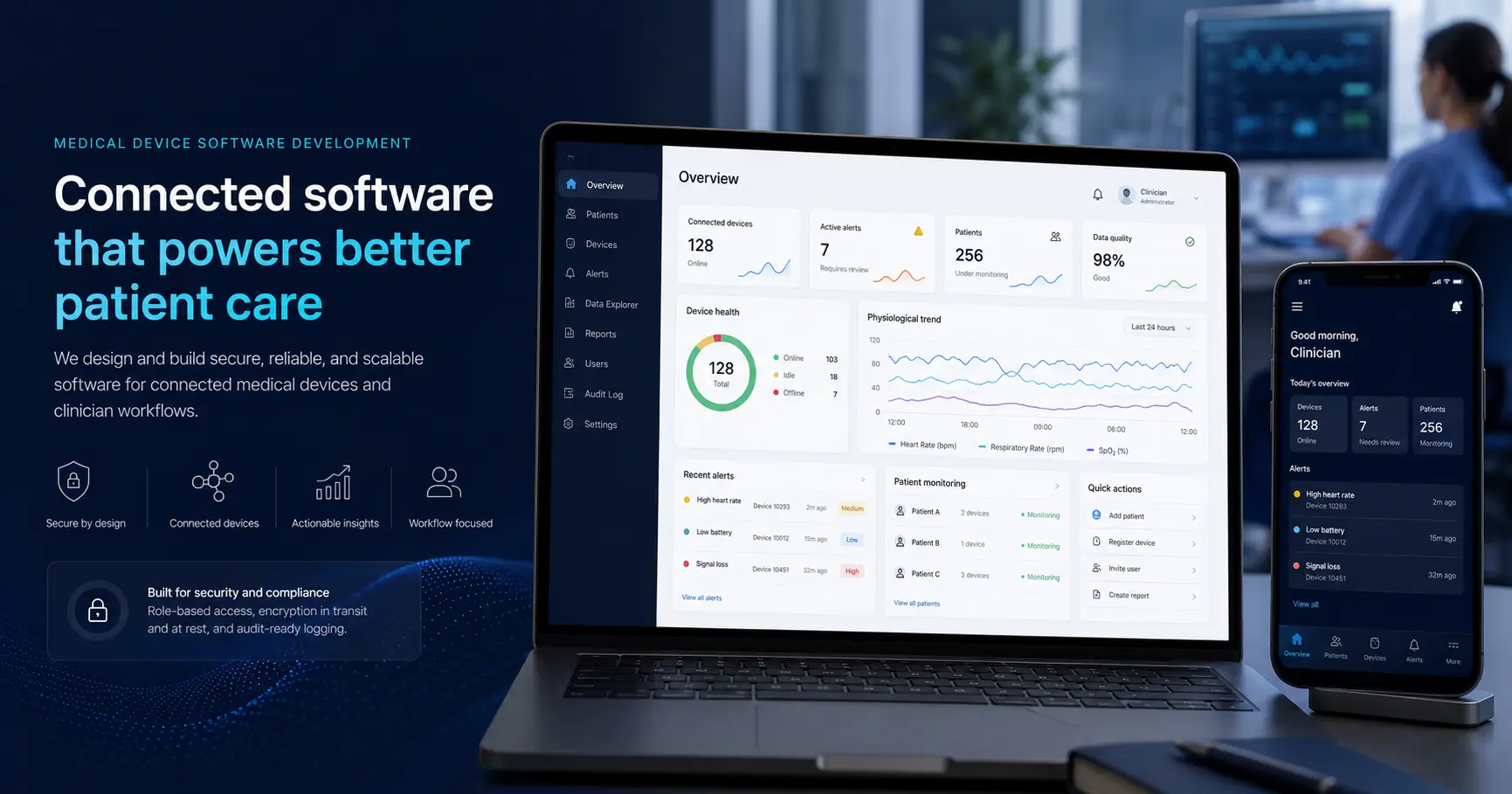
Secure Software for Connected Medical Devices
Medical device software operates in a context where data accuracy, security, and reliability matter more than almost anything else. Dev Entity builds software for companies developing connected health devices — from the mobile apps patients use to pair and monitor their devices, to the clinical dashboards that give healthcare teams a clear view of patient data, to the secure backends that store and integrate that data responsibly.
We work with medical device startups, healthcare technology companies, and enterprises adding connected device capabilities to their existing clinical platforms. Our approach starts with understanding your clinical context, your compliance requirements, and your user needs before we design anything.
Medical Device Software Development Services
Connected Medical Device Apps
iOS and Android applications that pair with connected medical devices via Bluetooth, Wi-Fi, or cellular — allowing patients and clinicians to view readings, control device settings, and receive alerts.
Patient and Clinician Dashboards
Web-based dashboards that aggregate device data, patient records, and monitoring results into a clear, role-appropriate view for clinical teams and healthcare administrators.
Health Data Visualization
Charts, trend graphs, and alert timelines that make time-series health data — heart rate, glucose, oxygen, temperature — legible for both clinical review and patient self-management.
Secure Backend Systems
Healthcare data backends built with encryption at rest and in transit, role-based access controls, audit logging, and cloud infrastructure designed with security and privacy requirements in mind.
Device Data Integration
Software integration layers that receive data from connected medical devices and translate it into structured records compatible with your clinical systems, EHR platforms, or data warehouse.
Alerts and Remote Monitoring
Event-driven alert systems that notify clinical staff or caregivers when device readings cross defined thresholds — reducing the need for constant manual monitoring.
Web Portals for Healthcare Teams
Secure web portals where clinical coordinators, nurses, and physicians can review patient device data, annotate records, manage device assignments, and generate reports.
Role-Based Access and Audit Trails
Granular access control systems that limit what each user role can view or edit — with immutable audit logs that record every data access and change for compliance review.
Building Software for a Connected Medical Device?
Tell us about your device, your target users — patients, clinicians, or both — and the data your software needs to handle. We will help you plan the right architecture and delivery approach.
Talk to our teamTechnology Stack
Medical device software requires technology choices that prioritise data security, cross-platform compatibility, and maintainability over long product lifespans. We select the right stack based on your device communication requirements, clinical environment, and compliance context.
Mobile: React Native
Cross-platform iOS and Android apps for patients and clinical staff — with Bluetooth and device communication support where required.
Frontend: React and Next.js
Secure web portals and clinical dashboards with role-based rendering and session management.
Backend: Node.js and Python
APIs and data processing services for device data ingestion, alert evaluation, and clinical record management.
Database: PostgreSQL with Encryption
Relational databases with column-level encryption, secure backups, and data integrity constraints for sensitive health records.
Cloud: AWS and Azure Healthcare Services
Cloud environments configured with security controls, data residency options, and managed services that support healthcare data requirements.
HL7 FHIR Integration
Standard healthcare interoperability format supported for integrating device data with EHR systems and clinical platforms.
What Good Medical Device Software Delivers
Secure health data handling
Software built with encryption, access controls, and audit logging to protect sensitive patient and device data from the start.
Better clinical visibility
Clinical teams get a clear view of patient device data without logging into multiple systems or waiting for manual data exports.
Remote patient monitoring
Connected device software enables clinical teams to monitor patients remotely — reducing in-person visits and improving response time.
Reliable mobile experience
Patients and clinicians can access device data, alerts, and records from their phones — with apps designed for the specific context of healthcare use.
Audit-ready documentation
Immutable audit logs and structured data records support compliance reviews, clinical audits, and regulatory documentation requirements.
Integration with clinical systems
Device data flows into EHR platforms and clinical databases automatically — reducing manual transcription and data quality issues.
Our Medical Device Software Development Process
Medical device software development requires more upfront planning than most software projects. Clinical context, user roles, data sensitivity, and compliance requirements all shape what gets built and how. We start with structured discovery rather than going directly to development.
Step 1
Requirements and compliance scope discussion
Step 2
System and data architecture design
Step 3
UI/UX for clinical and patient contexts
Step 4
Development with security controls
Step 5
QA, documentation, and security review
Step 6
Deployment and post-launch support
Timeline and Cost Factors
Medical device software cost and timeline depend on device communication complexity, the number of user roles and portals required, EHR integration scope, security architecture, and the depth of audit and reporting features. A focused patient-facing mobile app with a secure backend typically takes 12–20 weeks. A full clinical platform with dashboards, integrations, and role management typically takes 5–12 months. We scope each project carefully after understanding your device, your users, and your compliance environment.
Why Choose Dev Entity for Medical Device Software?
Frequently Asked Questions
What is medical device software development?
Medical device software development involves building the applications, dashboards, backends, and integration layers that support connected medical devices. This includes mobile apps that pair with devices, clinical dashboards that display patient data, secure backends that store and process health records, and APIs that connect device data to EHR systems. Dev Entity focuses on this software layer — we do not manufacture devices or develop firmware.
Can Dev Entity build apps for connected medical devices?
Yes. We build iOS and Android apps using React Native that connect to medical devices via Bluetooth or network communication, display device readings, send alerts, and allow clinicians or patients to manage device settings. The specific communication protocol depends on what your device supports.
Do you build HIPAA-compliant software?
We build medical device software with security, privacy, and compliance requirements in mind — including encryption at rest and in transit, role-based access control, audit logging, and secure cloud configuration. Whether a specific deployment meets HIPAA technical safeguard requirements depends on the full system design and your compliance team's review. We work with your compliance team throughout the project to support that process.
Can you integrate device data into clinical dashboards or EHR systems?
Yes. We build integration layers that receive data from connected devices and format it for use in clinical dashboards, EHR platforms, or data warehouses. Where EHR integration is required, we can work with HL7 FHIR-compatible systems. The specific integration approach depends on the APIs and data formats your target systems support.
Do you provide both mobile and web apps for healthcare teams?
Yes. We typically build both: a mobile app for patients or field clinicians who need device access from their phones, and a web-based portal for clinical coordinators, nurses, and physicians who work primarily at a desk. Both share the same backend and data model.
How do you handle security and access control?
Security is planned at the architecture level rather than added at the end. This includes encrypted databases, secure API design, certificate-based device communication where applicable, role-based access so each user only sees what they are authorised to see, session management, and audit logging. We also conduct security reviews before deployment.
Build Secure Software for Your Medical Device
Whether you need a patient-facing mobile app, a clinical monitoring dashboard, a secure backend for health data, or EHR integration — Dev Entity can scope and build the right solution. We work with healthcare technology companies and medical device teams across the US, UK, Canada, Europe, and Australia.